

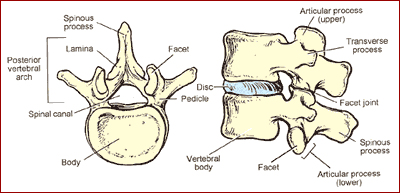
 The spinal column is a composed of 33 spine bones (vertebrae), with the lower 9 vertebrae being fused (grown together) called the sacrum and coccyx. The vertebrae are stacked on top of each other like building blocks with a cartilage cushion (intervertebral disc) in between each vertebra. Each of the vertebrae has a large, oval bony portion called the vertebral body. The vertebrae also have a large hole in the back part of the bone, behind the vertebral body, called the spinal canal. The spinal cord and nerves travel within the spinal canal, extending from the brain down to the tailbone. These nerves carry the signals from the brain to the muscles and the rest of the body.
The thick parts of the vertebrae forming the sides of the spinal canal are called pedicles. The thick bone comprising the back part of the spinal canal is called the lamina. The bony tip extending from the lamina (the part you can feel when you touch your back) is called a spinous process.
|
|
Each vertebra is connected to an adjacent vertebra by three joints: an intervertebral disc and two facet joints. The facet joints join near the back part of the spine on each side, near the lamina. The complex interaction between these three joints at each spinal level allows significant flexibility of the spine, but also ensures stability and resistance to injury.
The intervertebral disc is a soft cartilage cushion with two layers. The soft inner portion is called the nucleus pulposis, and the stronger outer ring is called the annulus fibrosis. The disc acts as a shock absorber and allows motion and bending of the spine.
The facet joints are small synovial joints on the back part of the spine on each side, connecting near the lamina. The facet joints have a strong, outer joint capsule.
 The upper portion of the spine is called the cervical spine, and is composed of 7 vertebrae. Except for the 1st and 2nd cervical vertebrae, all vertebrae have three joints at each level, an intervertebral disc in the front and two facet joints in the back. The cervical spine is extremely flexible, and therefore is quite prone to injury. The cervical spine also has small openings on each side the spine, for a special blood vessel carrying blood to the brain, called the vertebral artery.
The middle portion of the spine is called the thoracic spine, and is composed of 12 vertebrae. The thoracic vertebrae are firmly connected to the ribs and breastbone (sternum). There is very little movement or bending of the thoracic spine, and because of this, the thoracic spine is very strong and typically resists injury.
The lower portion of the spine is called the lumbar spine, and is composed of 5 vertebrae. There is significant flexion and extension movement in the lumbar spine, but minimal rotation. The lumbar vertebrae are the largest in the spine and bear the majority of the body’s weight, and endure significant loading and stress. Understandably, the lumbar spine is the most commonly injured region of the spinal column.
The lowest portion of the spine, the part that is connected to the pelvis, is called the sacrum. The sacrum is composed of 5 bones fused together. The coccyx is composed of 4 very small bones fused together, and forms the tailbone at the lowest part of the spinal column.